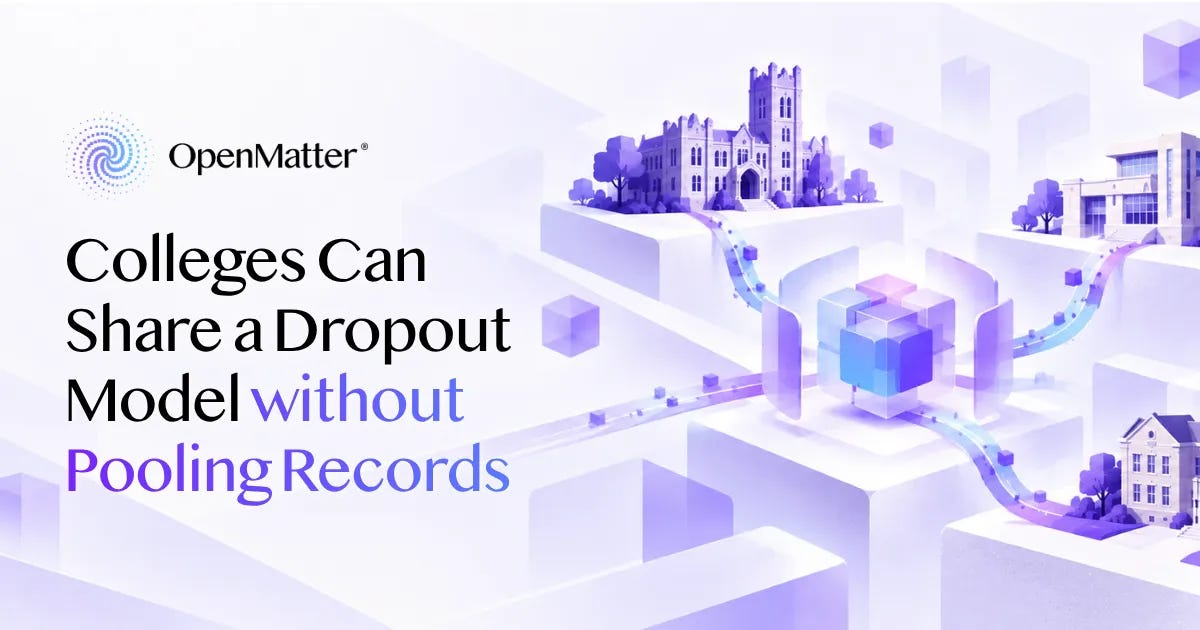
Colleges use prediction models to flag students who are likely to leave, so someone can reach them in time. The schools that most need those models often can’t build their own, and the privacy rules around student records keep schools from training on each other’s data.
This week we look at a study from Teachers College, Columbia University, that measured what a community college gives up when it borrows a model trained somewhere else. Below, we cover what the study found and how Masked Compute™ from OpenMatter® lets several colleges train one model together without any readable student record leaving its campus.
Stay up to date as we build the infrastructure layer for secure AI collaboration:

OpenMatter is chairing the Decentralized AI Agent Alliance’s Agentic Privacy & Security subgroup. Our next meeting will be held on October 21 at 1pm EDT, and every other Wednesday thereafter. Please join us.
If you’re curious what DAIAA is all about, you can check out their YouTube for a full archive of meeting recordings.
Colleges Can Share a Dropout Model without Pooling Records
How Masked Compute Lets Several Schools Train One Model on Records None of Them Hand Over
Every school has part of the answer to which students leave. It sits in records of attendance, grades, financial aid, and the courses students took first. A well-resourced school’s records can answer the question for that school. A fuller answer needs records from many campuses, and privacy rules keep those records apart. In the United States, student records fall under FERPA, the federal privacy law for education records.
The schools that most need an answer have the least to work with. Community colleges enroll more students from disadvantaged backgrounds than four-year schools do, and fewer of their students stay. The National Student Clearinghouse measured the share of students who started college in fall 2024 and were still at the same school a year later: 56.2% at community colleges, against 79.4% at public four-year schools. Many community colleges also lack high-quality data and technical expertise to build their own model for predicting which students will leave. At best they use a model a vendor trained somewhere else, with what three Columbia researchers call “limited transparency or local customization.”
Borrowing a Model Instead of the Data
Those researchers — Chengyuan Yao, Carmen Cortez, and Renzhe Yu of Teachers College, Columbia University — trained models that predict which first-year students return for a second year. Their study was published for the Learning Analytics and Knowledge conference in March 2025. Through research partnerships, the researchers had access to student records from 27 schools: four public research universities in three states and 23 community colleges in one southeastern state. The records covered more than 800,000 students who started college for the first time between 2013 and 2019.
The study kept to the rule colleges live under. FERPA “generally prohibits the disclosure of personally identifiable information from student records without written consent,” so every analysis in the study assumes that “there is never data sharing across institutions.” Each model was trained on one school’s records and tested on a community college’s records, as if that college had borrowed it.
Models predicted less well when moved to a new school without adjustment. Their fairness, meaning how evenly they performed across groups of students defined by gender and underrepresented-minority status, varied widely depending on the source school. The drop in performance was predictable from public data about the schools: the less a source school resembled the college using its model, the bigger the drop. Choosing the most similar school as the source beat a randomly chosen source at 21 of 23 community colleges. The better-matched model still fell short of a model trained on the college’s own past students, which many community colleges lack the capacity to build. Matching on similarity also did no better on fairness than a random pick.
Training the best-matched model a second time, on records from a school whose students differed most from the first’s, narrowed the fairness gap at 8 of the 11 colleges where that model was least fair. The model moved, and the records stayed where they were. A more varied training set can help with fairness, the authors note, but “privacy constraints prevent model developers from combining data from multiple institutions.”
Training on Records Nobody Hands Over
Some schools already pool student records by handing them to a third party. In the Clearinghouse’s Postsecondary Data Partnership, colleges send in course and cohort files, the Clearinghouse processes the data, and each college gets back dashboards and benchmarks against its peers. Pooling that way works, but it means one organization holds every participating school’s student records.
Masked Compute from OpenMatter skips both the borrowing and the custodian. Several schools train one model together, and each school’s original records stay on its own campus instead of being collected in one place. Schools that already share records under an agreement could train together without handing those records over.
Each school runs a small program, the agent, on its own machine. The agent reads the school’s data from a CSV file, a database, or cloud storage. It splits each student’s row into five shares and sends one to each of five separate compute servers on OpenMatter’s network. No server ever receives a whole row, and no single share reveals anything about the student. The only readable data that leaves the school is the column names and types. The servers train the model on the shares, never on readable student records, and every school gets the same finished result: the trained model and how well it fits the data.
The method underneath is multiparty computation, a branch of cryptography in which several machines compute a result together without any of them seeing the inputs. Each school’s agent checks the result against cryptographic tags that expose tampering. The session closes only when every school confirms it received the same answer, and the agreement on the result is recorded onchain.
Compared with a borrowed model, a session changes two things. The model learns from every participating school’s students instead of one other school’s. And each school gets the trained model itself, built on its own records along with everyone else’s, instead of a vendor’s model it can’t see inside.
What Runs Today
A session can include the host and up to four other schools. The host starts it in OpenMatter’s Datavizor™ console, and the others join with an invite code. Each school downloads the agent from the console. The agent runs on Linux and Apple silicon Macs, with Windows listed as coming soon. Session traffic runs over a VPN, a private encrypted link. The VPN protects the shares in transit, while Masked Compute protects them during computation.
The models come from MatterML™, OpenMatter’s engine for training on masked data. Logistic regression, a standard model for yes-or-no questions like whether a student returns, trains across schools today on MatterML V1. Linear regression, which predicts a number, already runs on V2. In OpenMatter’s own testing, V2 cut a linear regression session from around two and a half hours to about two minutes. Logistic regression is moving to V2 and runs at V1 speed until it does.
Where the Study Leaves Off
The Columbia study measured what a college gives up when the only model it can use was trained on someone else’s students: predictive performance and fairness. A better-matched source won back only part of the performance. The authors named privacy rules as what keeps model developers from combining colleges’ records into the more varied training set that could narrow the fairness gap. A Masked Compute session trains on several schools’ records together, but no readable record leaves its campus.
If your college wants a model trained on more students than it has, start a session in Datavizor and send another school the invite code.
— The OpenMatter Team
If you know someone who would benefit from reading this article, please share it:
OpenMatter is building the verifiable trust layer that enables AI agents to securely collaborate on sensitive data sets. If you’re in a regulated industry and need a better way to prove that your data is secure, contact our team to learn how masked compute can help.