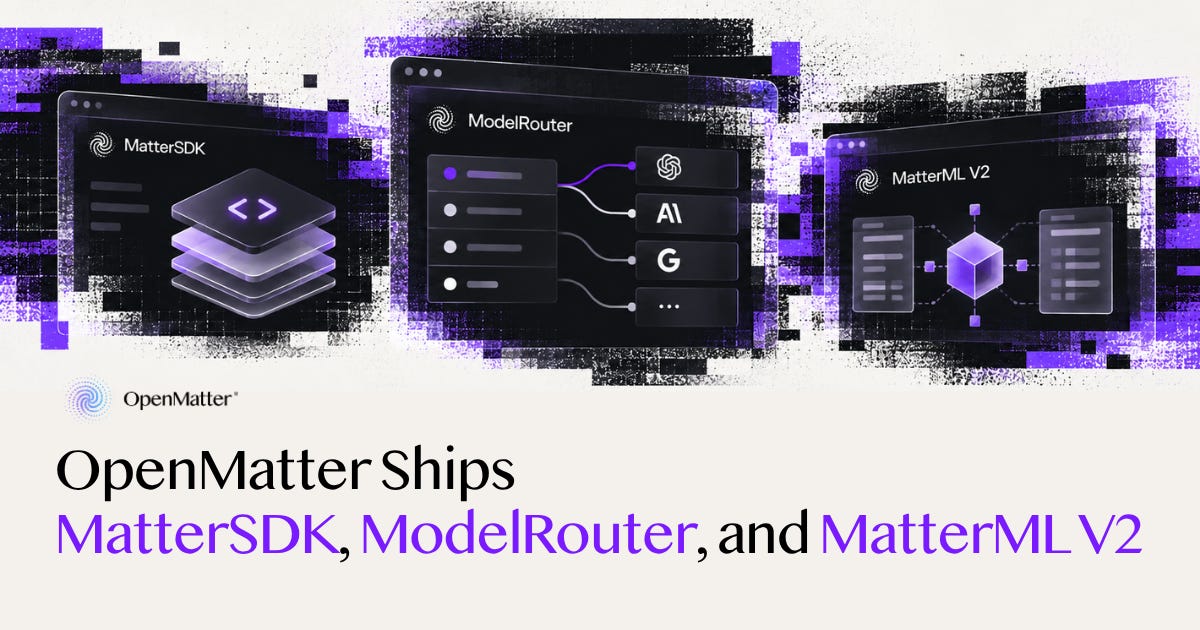
There should be a few baseline requirements for the agentic economy. Among those, your API keys should not be sitting inside your agents. Changing which model you use should not mean a code change and a redeploy. And the data that would make your model better should not be off limits because another company holds it.
OpenMatter® shipped updates last week that address all three. MatterSDK™ gives you our key handling as a library. ModelRouter™ puts every model behind one address, with no provider key in your apps and one place to manage them. And MatterML™ V2 cuts a joint training session between two companies from hours to minutes. These are major upgrades, and this week’s article shows you each one in the Datavizor™ console.

Stay up to date as we build the infrastructure layer for secure AI collaboration:

OpenMatter is chairing the Decentralized AI Agent Alliance’s Agentic Privacy & Security subgroup. Our next meeting will be held on September 23, 2026 at 1pm EDT, and every other Wednesday thereafter. Please join us.
If you’re curious what DAIAA is all about, you can watch the September 9 meeting to learn more.
OpenMatter Ships MatterSDK, ModelRouter, and MatterML V2
Three Additions to the Platform, and What Each One Does
If you run AI in production, you probably have all three of these problems:
Your provider keys sit inside agent environments. Anything the agent can read, an attacker who gets in can read too.
Changing which model you use means editing code and redeploying, so you stay on a model longer than you want to.
The data that would most improve your model is held by another company that cannot share it with you.
Last week OpenMatter shipped updates aimed at all three. Here is what each one does, and what it looks like in the Datavizor console.
MatterSDK: Our Key Handling, Now Yours to Use
If you have used the console, you have already been running threshold cryptography without knowing it. When you paste an API key into a deployment, it is encrypted in your browser before it leaves the page, then split into pieces held by separate machines. No single machine holds enough to put the key back together. That system is MatterVault™.
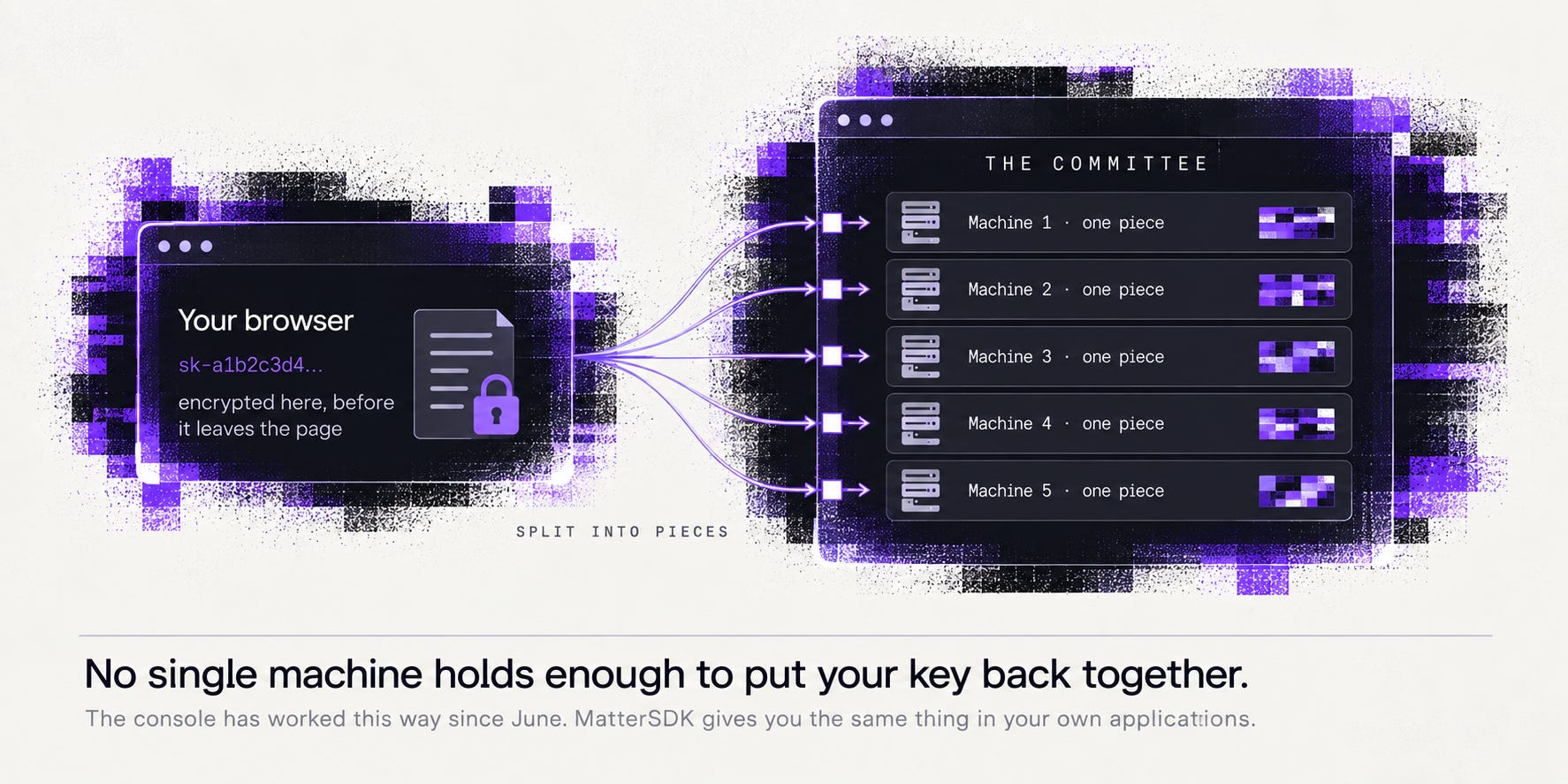
MatterSDK gives you the same system in your own applications: one library for storing secrets, retrieving them, and reaching MatterChain. You never interact with the underlying cryptography — it’s all abstracted away.
This saves an employee expense. Key management this effective normally requires a cryptography specialist. MatterSDK removes that requirement. The benefits of this are lower costs, ease of use, wider availability, and better security.
ModelRouter: Every Model at One Address, No Keys in Your Apps
ModelRouter is a gateway you run inside your organization. You add each provider key once — OpenAI, Anthropic, OpenRouter, Google — or point it at a model server you run yourself using Ollama, vLLM, LM Studio, or llama.cpp.
Your key is encrypted in your browser and stored in MatterVault, held by the key generation committee. The gateway unseals it only while it is serving a request, and never writes it to disk. Your applications and agents get a gateway token and one address instead.
No provider key is ever stored in your apps or your agents. If one of them is compromised, there is no key there to take.
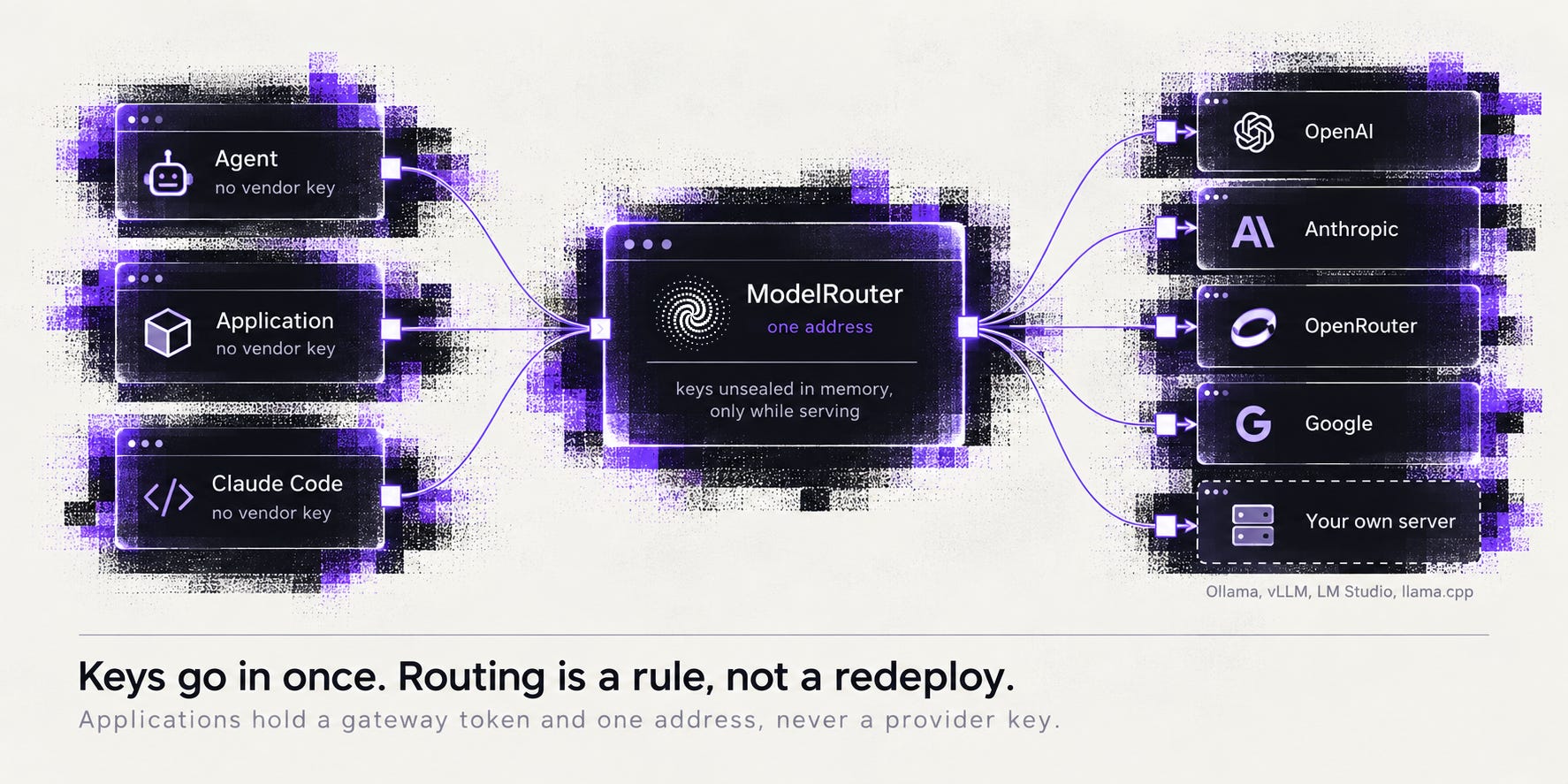
You set up routing as an ordered list of rules. Each rule looks at the text and length of the prompt. Send short questions under 500 tokens to a small model, anything containing the word “contract” to a larger one, and everything else to a final rule. Each rule can name a second model to try. A failed call is retried once.
Changing which model responds means editing a rule, not a code change or redeploy. When a better model comes out next quarter, you adopt it by editing a routing table.
The routing design is simple but brilliant. The whole table reads top to bottom like a list of plain sentences, and a Test Route button asks the running gateway what it would do with a prompt before you commit.
Your existing tools keep working. Anything built for the OpenAI or Anthropic API format can point at the gateway, Claude Code included. If your tool speaks one format and the model speaks the other, the gateway translates between them.
The usage numbers do have limits. Counters live in the gateway’s memory, cover 31 days, and reset when the gateway restarts. Anything unmeasured shows a dash rather than a zero, so you can tell the difference between nothing happening and nothing being recorded.
MatterML V2: The Same Joint Training, Now in Minutes
MatterML V2 is an upgrade rather than a new capability. Two companies could already train a single model over data neither of them shares. That shipped in June. What V2 changes is how long it takes and how many engineers it needs. And the update is automatic — there’s nothing a user needs to do; everything just works faster now.
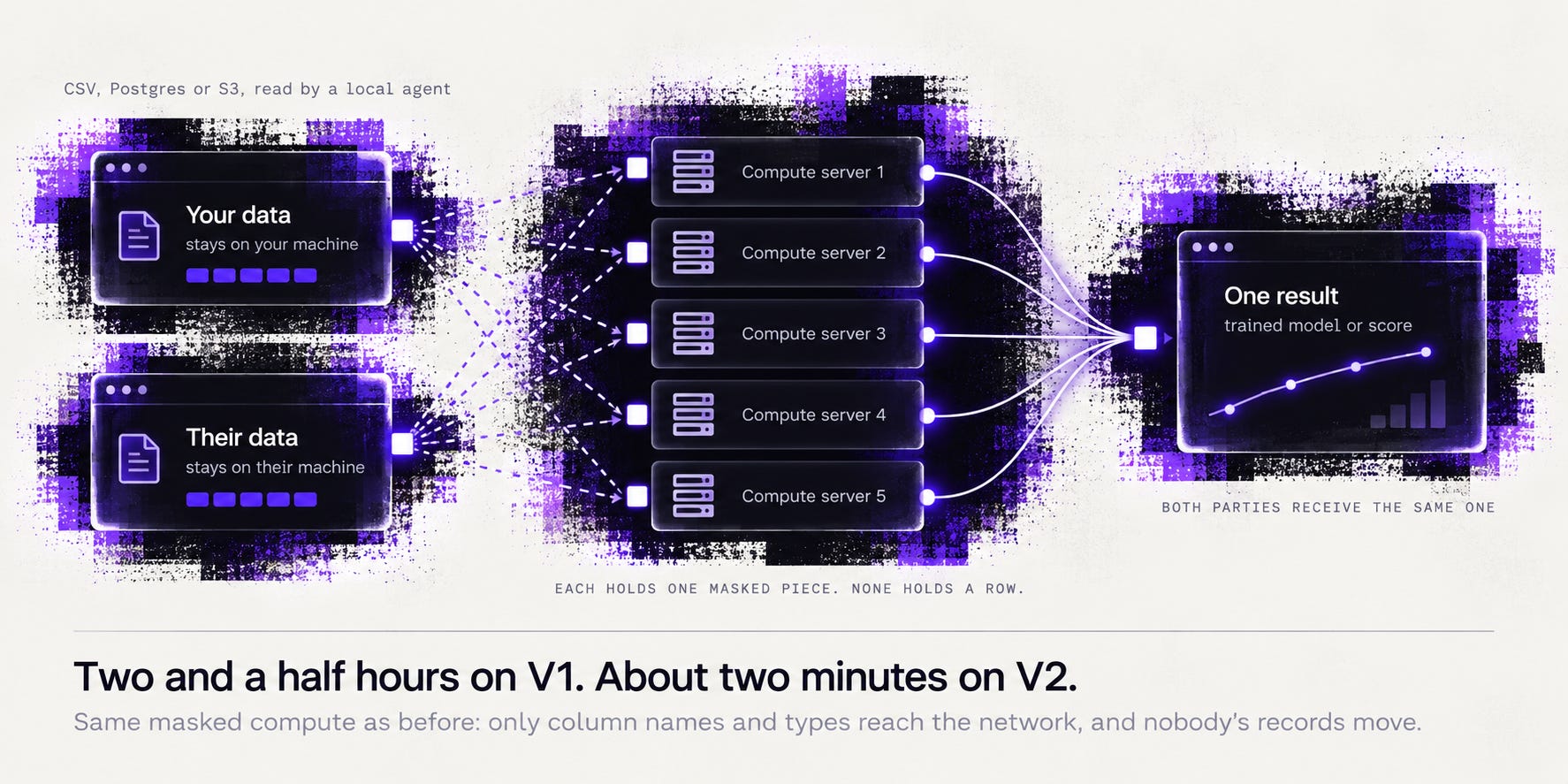
In OpenMatter’s own testing, a session that took around two and a half hours now finishes in about two minutes. That is the largest performance gain OpenMatter has shipped since launch.
You and a partner train one model over data neither of you shares. Each side runs a small agent on its own machine. The agent reads a CSV file, a Postgres table, or an S3 bucket. It splits each row into five masked pieces and sends one to each of five separate compute servers. No server ever holds a whole row. Only the column names and types reach the network. Both of you get the same finished result.
That is how you get at questions that otherwise go unanswered: how your pay gap compares with another firm’s, whether a model trained on one hospital’s patients holds up on another’s, what actually drives settlement values across firms. We detailed six real-world applications of our technology in August.
V2 also moves this into the console. You start a session or join one with an invite code, instead of arranging it between engineers. Getting the agent used to mean asking someone for a build. Now it has its own download panel in the walkthrough: version 1.9.0, for Linux and Apple Silicon, with Windows listed as coming soon.
Today linear regression runs on the new V2 engine, while logistic regression and random forest still run on V1. So any job that uses those two models runs on V1 for now. Both will be updated to run on V2.
What the Three Add Up To
The browser-side encryption behind MatterSDK is the one the console has used since launch. The masked computation behind MatterML V2 is the same, now faster and reachable from the console. ModelRouter sits in front of models you were already calling. The chain still records what ran.
OpenMatter co-founder Renee Davis put it this way: “Customers should be able to take advantage of new models, new cryptographic techniques and new ways of collaborating without having to replace the foundation underneath them every time computing changes.”
Don’t trust data. Prove it. Datavizor is the console through which you can see how our verifiable trust layer fits your stack. Add a provider key and watch it encrypt before it leaves your browser. Deploy a gateway and point Claude Code at it. Start a session with a partner and an invite code. Begin at datavizor.openmatter.network.
— The OpenMatter Team
If you know someone who would benefit from reading this article, please share it:
OpenMatter is building the verifiable trust layer that enables AI agents to securely collaborate on sensitive data sets. If you’re in a regulated industry and need a better way to prove that your data is secure, contact our team to learn how Masked Compute™ can help.