Most data security rests on the assumption that someone, somewhere, gets to see the data. That someone is usually the hardware it runs on, the cloud it sits in, or the company you handed it to. Masked compute was built to remove that assumption.
With MatterML, we just shipped our first machine-learning circuit. It’s a linear regression model, running across data that separate organizations hold and aren’t allowed to combine. It’s the first model to go all the way from cryptographic theory to production.
We’re pretty excited, so here’s what it is, why it matters, and what’s next.

OpenMatter is chairing the Decentralized AI Agent Alliance’s Agentic Privacy & Security subgroup. The first meeting will be held on July 1, 2026 at 12pm EDT, and continuing every other Wednesday thereafter. Please join us.
OpenMatter’s First ML Circuit Is Live
Linear Regression Has Shipped, with More Models Arriving Soon
Picture several hospitals, each holding patient records it can’t legally share. None of them has enough data to train a reliable model. Together they would, but pooling records that sensitive is forbidden.
MatterML is OpenMatter’s machine-learning engine for masked compute, and it was built to close exactly this gap. It turns standard models into circuits that let those hospitals train a shared model across all of their records without exposing a single one.
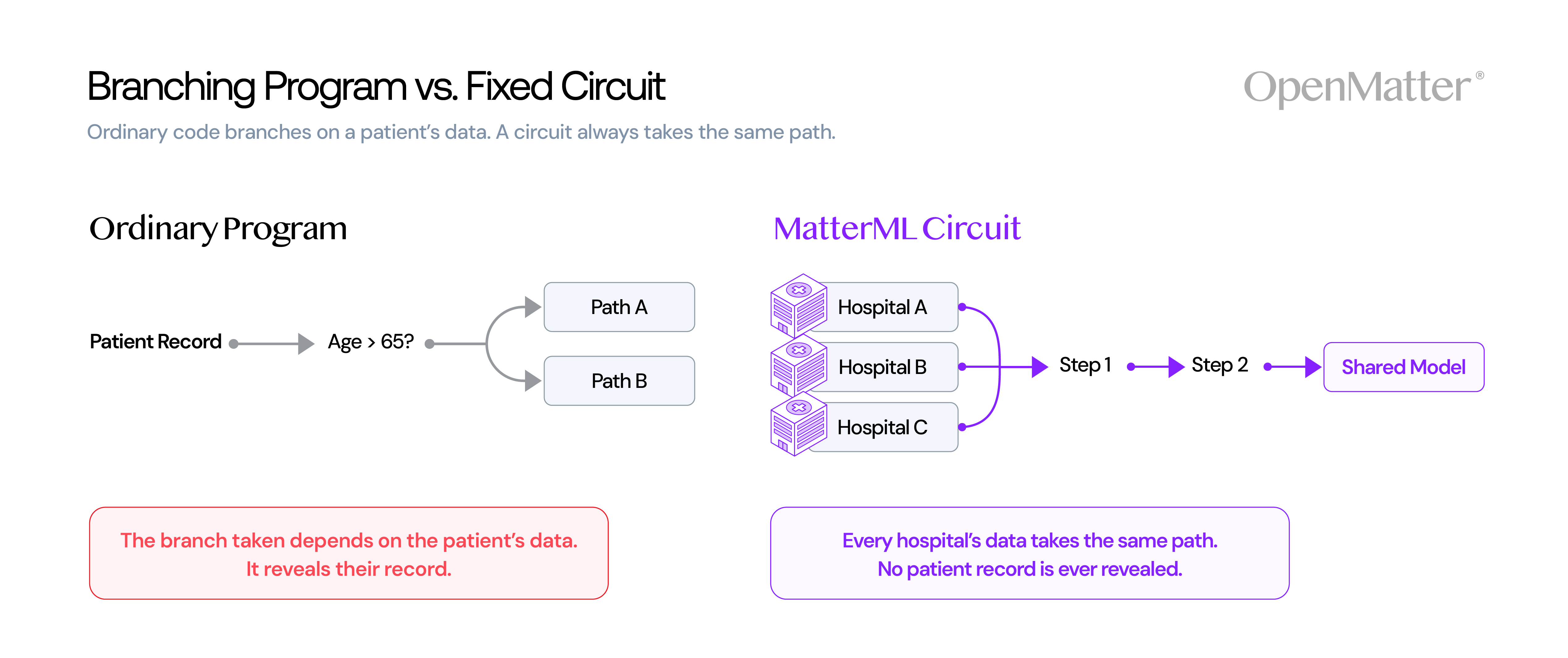
The basic idea is that the data is split into shares and spread across separate computers, so no single computer ever sees it all. The model runs across all the shares at once. When it finishes, it produces a zero-knowledge proof that the work was done correctly and that nothing private was exposed.
Before we get into what we just shipped, let’s learn a little about what makes circuits special.
Why Circuits?
A normal computer program is full of branches and decisions that depend on the data. The cryptography MatterML relies on can’t work that way. It needs the computation written out as a fixed sequence of simple math steps, settled in advance. That layout looks a lot like an electrical circuit, which is where the name comes from. Every input travels the same path, so the computation can’t branch off in a way that reveals something about the data. The trade-off is that each model has to be rebuilt as its own circuit.
Under the hood, the work runs in two stages. A heavier prep stage handles the math up front, and a fast online stage uses it to compute on the shares without ever putting them back together. A separate proof confirms the run was correct. The cryptography is quantum-safe, designed to hold up even against future quantum computers, so a proof you generate today should still stand years from now.
MatterML’s Roadmap
Linear regression is live now and working across multiple parties, the first model to make it all the way to production. Several more are close behind in testing, with neural-network variants still in development. Here’s where each one stands:
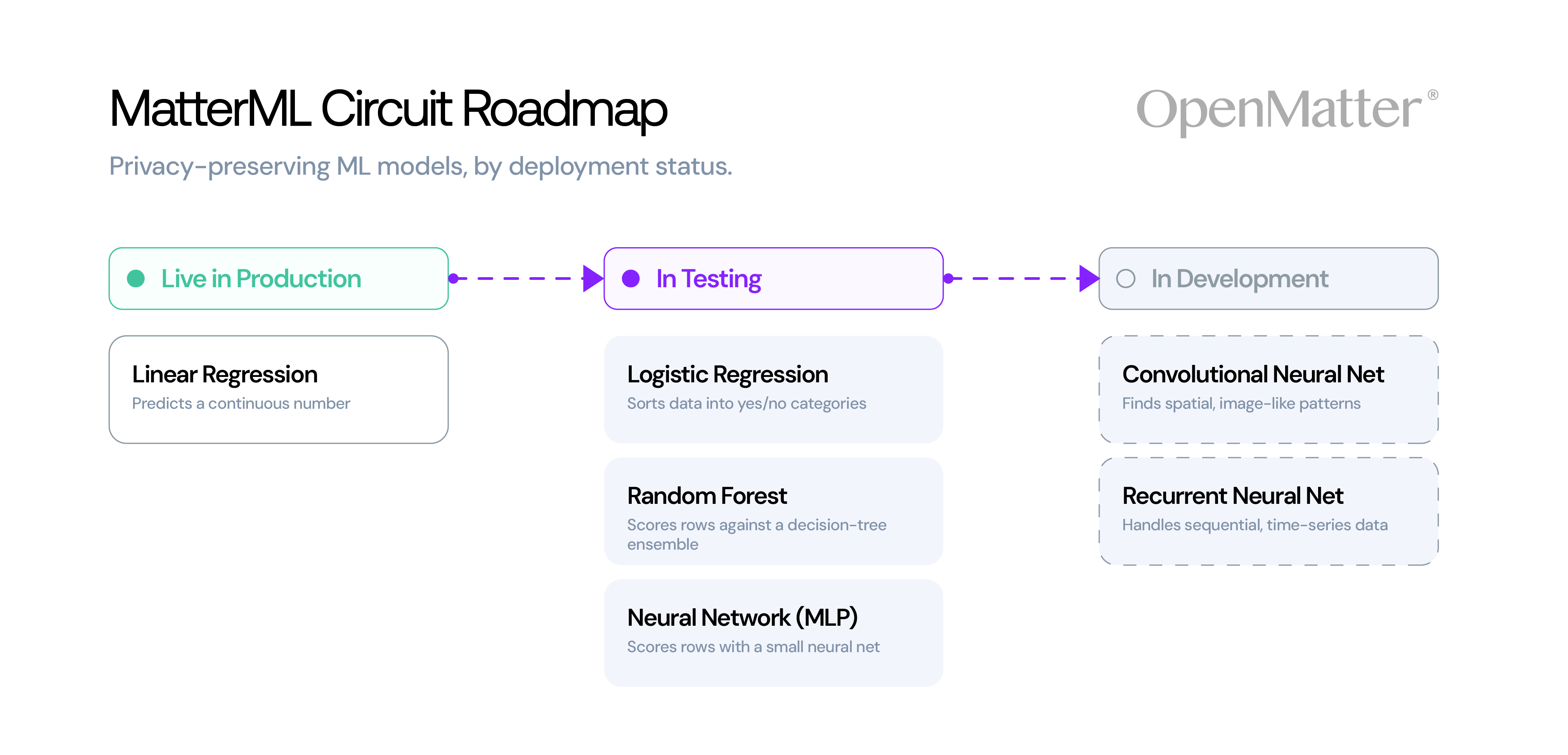
Together they cover most of what organizations actually do with data: predict a number, sort things into categories, or learn a pattern.
What Linear Regression Does
We shipped linear regression first, and it’s about as fundamental as machine learning gets. You give it some inputs and a number you want to predict. For example, input a patient’s age and blood pressure to estimate their length of stay. It learns how much each input matters and combines them into a prediction. The result tells you the weight of each factor, plus a few simple scores for how well the model fits.
On its own, that’s not novel. What’s new is that MatterML can now fit it across data that several organizations hold separately and aren’t allowed to combine.
Running a Circuit
Using MatterML is straightforward. You start a session, connect your data, pick a model, choose which columns to predict from and which to predict, and run. MatterML sets up a secure connection between the participants, runs the circuit, and returns the same result to everyone: the model, its coefficients and fit scores, and the proof. It ships as two containers: one for the compute nodes, and a local one that prepares your data before it enters the system. The MatterML circuit works as middleware, so an existing AI agent can route through it as is.
The Results Rest on Math
Most ways of computing on sensitive data come down to trusting someone. MatterML asks for none of that. The proof it produces can be checked by anyone, so the result rests on math, not on trust.
For healthcare providers, and anyone else holding data too sensitive to share, that’s the difference that matters. You don’t have to believe the result. You can verify it.
— The OpenMatter Team
Watch CEO and co-founder of OpenMatter, Renee Davis, discuss why OpenMatter is building the infrastructure layer for secure AI collaboration.
Industry Updates
Phished Like a Person
Researchers at Varonis built an ordinary email agent on the open-source OpenClaw framework, gave it a Gmail inbox and Google Workspace, and seeded its world with realistic secrets: AWS keys, database credentials, CRM exports. Then they ran the same phishing playbook that has fooled people for decades, and it worked on the agent too. The notable part is the control group: one configuration had explicit phishing-awareness instructions written into its prompt, and that still wasn’t a dependable backstop. Telling a model to be careful isn’t the same as making carelessness impossible. The instruction layer is exactly the layer an attacker gets to write to, which is why the controls that hold live outside the model, on what data an action can touch and what’s allowed to leave.
France Won’t Certify the Old Math
At the France Quantum conference this week, the national cybersecurity agency ANSSI said it will stop certifying security products that lack quantum-resistant encryption from 2027, and expects businesses to buy quantum-safe products by 2030. Because ANSSI certification is effectively required for operators of government and critical infrastructure, that turns post-quantum readiness from a recommendation into a procurement gate. The driver is harvest now, decrypt later: store today’s encrypted traffic, wait for a machine that can open it. An official called the shift “a matter of governance, industrial planning, regulation, and sovereignty,” not just a technical fix. For anyone building now, swapping in a quantum-safe algorithm is the easy half. The harder, more durable half is an audit trail you can still verify in a decade, whatever the cryptography underneath has become.
OpenMatter is building the verifiable trust layer that enables AI agents to securely collaborate on sensitive data sets. If you’re in a regulated industry and need a better way to prove that your data is secure, contact our team to learn how masked compute can help.