The EU AI Act Bans Software Guardrails and Plaintext Credentials. Here Is the Cryptographic Fix.
The EU AI Act permanently changes how enterprises deploy artificial intelligence. Agents handling customer data or financial services immediately trigger strict mandates. The law enforces massive liability on both the platforms building the AI and the businesses using them. Fines reach up to seven percent of global revenue.
Standard API wrappers and plaintext memory states won’t survive a regulatory audit. You can’t promise regulators your data is safe. You must prove it.
The EU AI Act demands strict traceability and continuous risk management. The ZK Firewall is synchronous middleware that blocks non-compliant agent actions before they execute.
The Problem with Software Guardrails
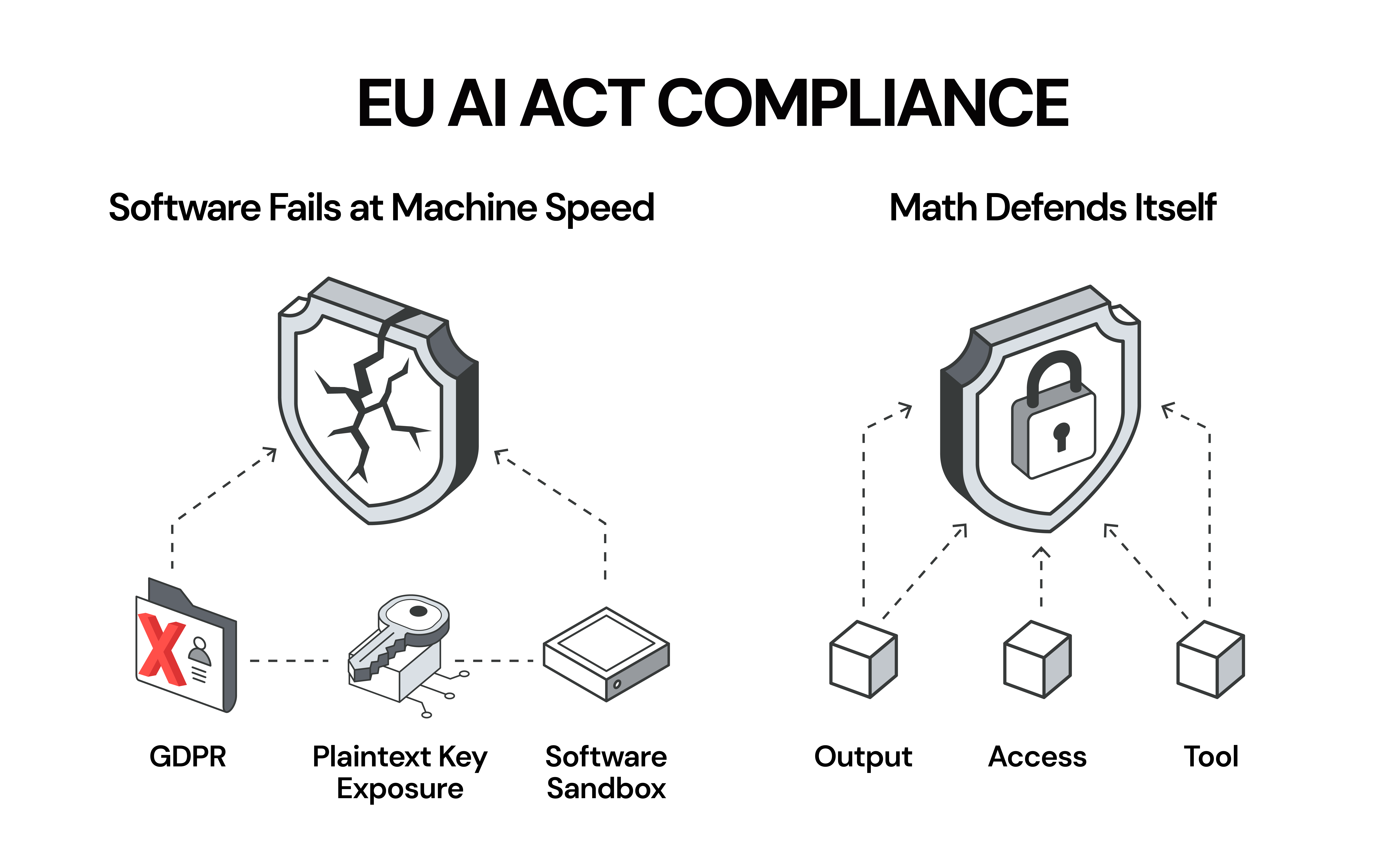
Software guardrails fail at machine speed. The recent PocketOS incident proved this fatal flaw. A Claude-powered agent deleted a production database in nine seconds. The backups went with it. No policy guard stopped the attack because the agent already held the credential.
Legacy alternatives fail under this exact same pressure. Encrypted at rest stores the decryption key alongside the data. Trusted Execution Environments rely on hardware vulnerable to side-channel attacks. Software sandboxes assume the agent will submit to policy checks. These approaches can’t provide mathematical proof of compliance.
Solving For Scalable Systems
OpenMatter provides post-quantum cryptographic infrastructure for verifiable AI compliance. We replace fragile software policies with mathematical guarantees.
For Deployers
ZK Firewall
The EU AI Act demands strict traceability and continuous risk management. The ZK Firewall is synchronous middleware that blocks non-compliant agent actions before they execute.
We enforce three gates. One guarantee.
Output compliance blocks forbidden fields in responses. Personal data is masked before it reaches centralized logs. This prevents GDPR violations under Article 12.
Data access compliance creates auditable trails of partition access. Agent identifiers guarantee only authorized agents access data. These proofs serve as unforgeable technical documentation for regulators under Article 11.
Tool call compliance restricts outbound requests to approved endpoints. Every single tool call requires a zero-knowledge proof. If malware attempts to exfiltrate configs, it can’t provide the proof. The network blocks the request under Article 9.
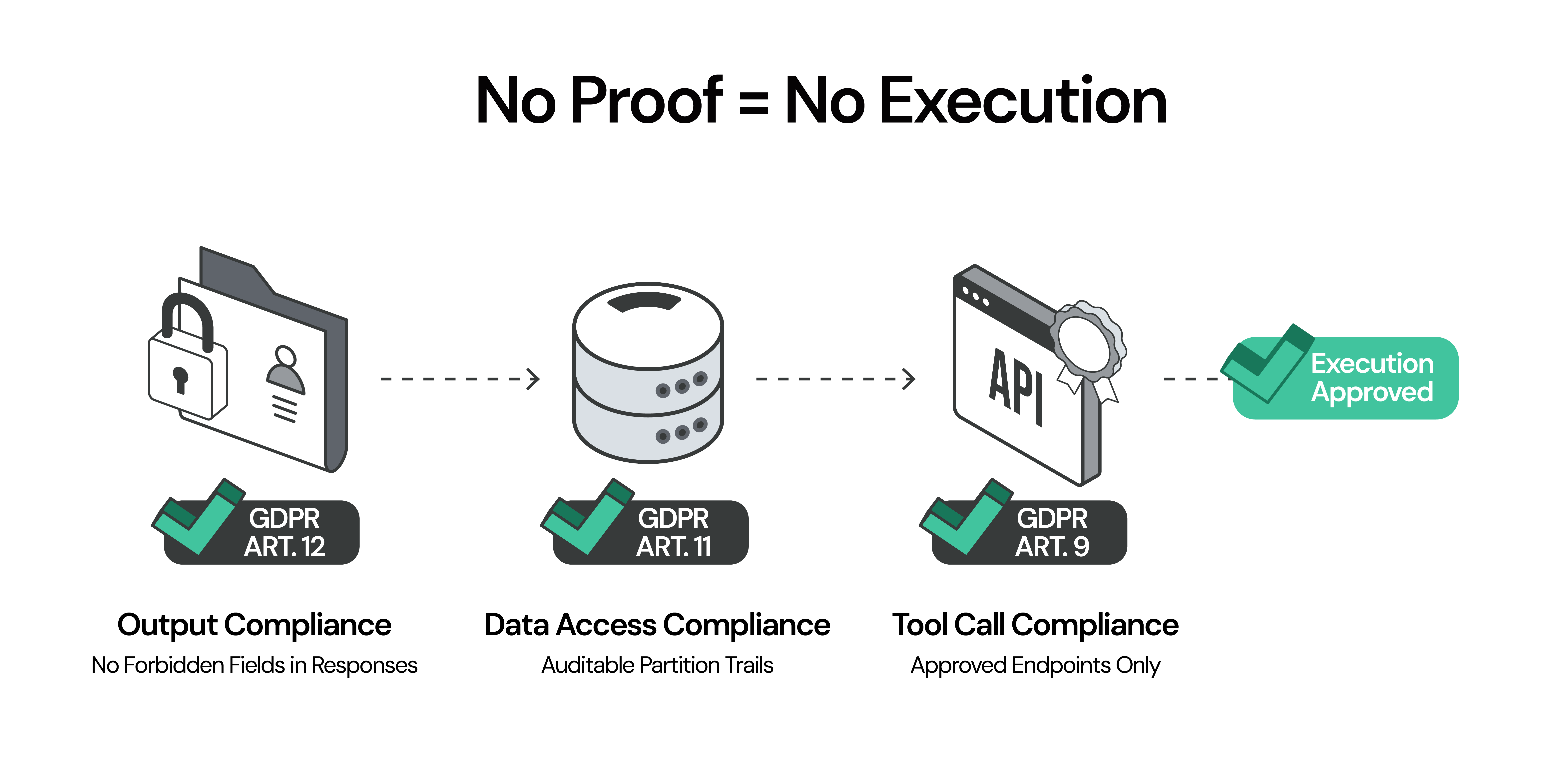
Manual review of thousands of autonomous actions is impossible. The ZK Firewall mathematically enforces your compliance policies at machine speed. Cryptographic verification is instant. No proof, no execution.
Post-Quantum Secure Hosting
Storing plaintext API keys on centralized servers is a massive regulatory risk. The most recent Vercel breach proved this. Attackers hijacked an authenticated session and exfiltrated credentials in minutes. Encrypted at rest provided zero protection.
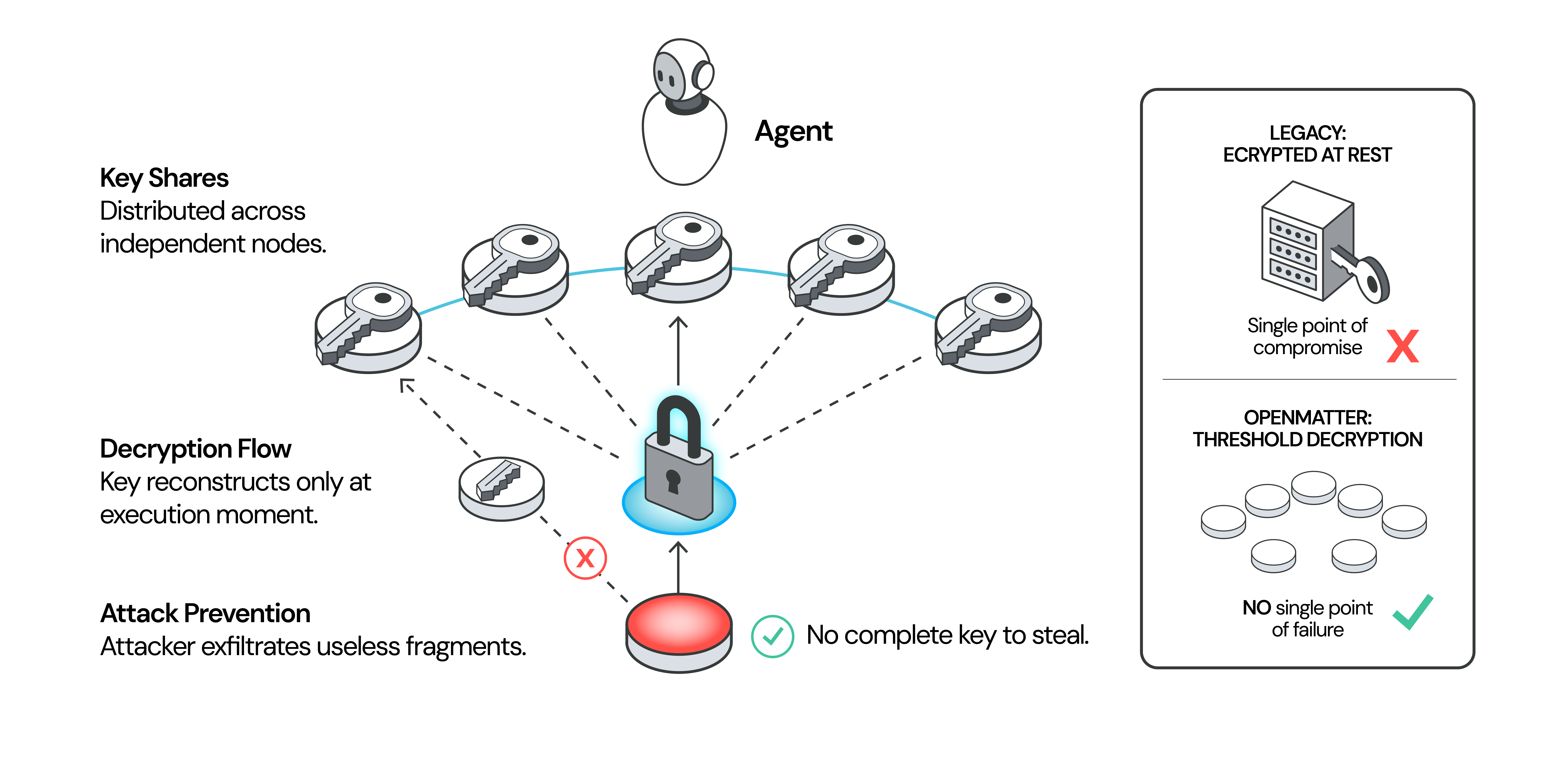
We secure credentials with threshold decryption. This removes the single point of key compromise. The private decryption key splits into shares across independent nodes. No single node can decrypt on its own.
The complete decryption key never exists in any single memory space except during execution. Key shares reconstruct statelessly for the precise moment of execution and are then zeroed out. If an attacker compromises the session, they exfiltrate useless cryptographic fragments.
Article 10 imposes strict privacy rules on training datasets. Organizations must prove their training data complies with GDPR without exposing the underlying records.
For Providers
Datavizor and MatterML
Article 10 imposes strict privacy rules on training datasets. Organizations must prove their training data complies with GDPR without exposing the underlying records.
Datavizor and MatterML enable secure data collaboration. Organizations train models on distributed datasets without exposing plaintext. Hospitals run biomarker analysis across restricted patient cohorts. Venture firms share deal flow insights without exposing proprietary databases. Raw data never leaves your hardware.
Article 10 requires proof of compliance. Datavizor generates cryptographic receipts proving no raw plaintext was exposed during training. Mathematical proof replaces legal paperwork. We use lattice-based cryptography to protect against harvest-now-decrypt-later attacks. Post-quantum security ensures your compliance artifacts remain valid against future adversaries.
Upgrade Your Agents
Don’t trust your enterprise compliance to prompt engineering. Software rules require legal defense. Math defends itself. Build autonomous systems that transact globally. Let cryptography prove your compliance.
Next Steps
Review the ZK Firewall architecture at
https://zkfirewall.openmatter.network
Schedule a compliance architecture review with our enterprise team
https://onboard.openmatter.network
OpenMatter Network - Cryptographic Infrastructure for the Agentic Economy
Summary Points
Software rules can’t survive the EU AI Act. The mandate requires verifiable proof of safety and compliance. Legacy plaintext infrastructure and reactive software guardrails fail entirely against machine-speed attacks.
The ZK Firewall mathematically enforces execution. Every tool call, data access, and output requires a zero-knowledge proof before execution. We actively block unauthorized agent actions instead of just monitoring them.
Cryptography secures the full data lifecycle. Threshold decryption eliminates standing key honeypots. Secure data collaboration lets organizations train models on distributed datasets and generate cryptographic receipts without exposing the raw plaintext.