Apps and agents that use several AI models need a gateway: one address that passes each request to the right model. There are three common ways to get one. You can pay a hosted service like OpenRouter to run it. You can install an open-source gateway like LiteLLM on your own servers. Or you can deploy OpenMatter®’s ModelRouter from the Datavizor™ console.
Last week we showed how ModelRouter works. This week is about what it does for your business: lower model bills, less engineering work, and safer provider keys (the API keys tied to your paid model accounts). We compare it with the alternatives on each.
As you’ll learn, if you’re already using OpenRouter, you don’t have to rip it out. ModelRouter treats it as one endpoint among several, alongside your direct provider keys and any models you host yourself.

Stay up to date as we build the infrastructure layer for secure AI collaboration:

OpenMatter is chairing the Decentralized AI Agent Alliance’s Agentic Privacy & Security subgroup. Our next meeting will be held on October 7, 2026 at 1pm EDT, and every other Wednesday thereafter. Please join us.
If you’re curious what DAIAA is all about, you can watch the September 23 meeting to learn more.
Why Teams Choose ModelRouter over OpenRouter and LiteLLM
Lower Model Bills, Less Engineering Work, and Safer Provider Keys
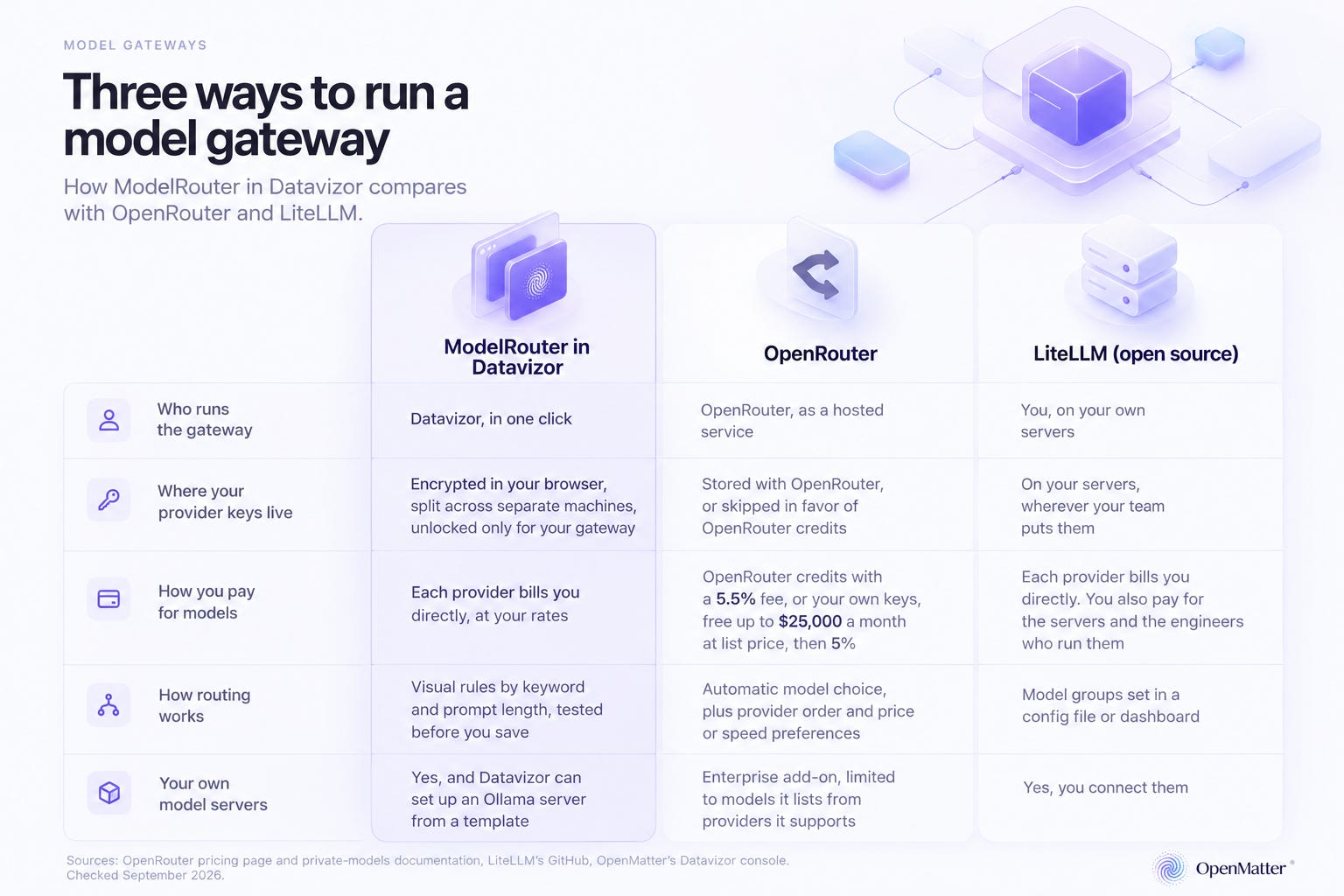
OpenRouter, LiteLLM, and ModelRouter all give your apps one address for many models. The difference is what each one costs you. With ModelRouter, there’s no gateway server to run, your keys are stored in pieces no single machine can read, and your own model servers sit beside every provider in one console.
Cut Your Model Bill
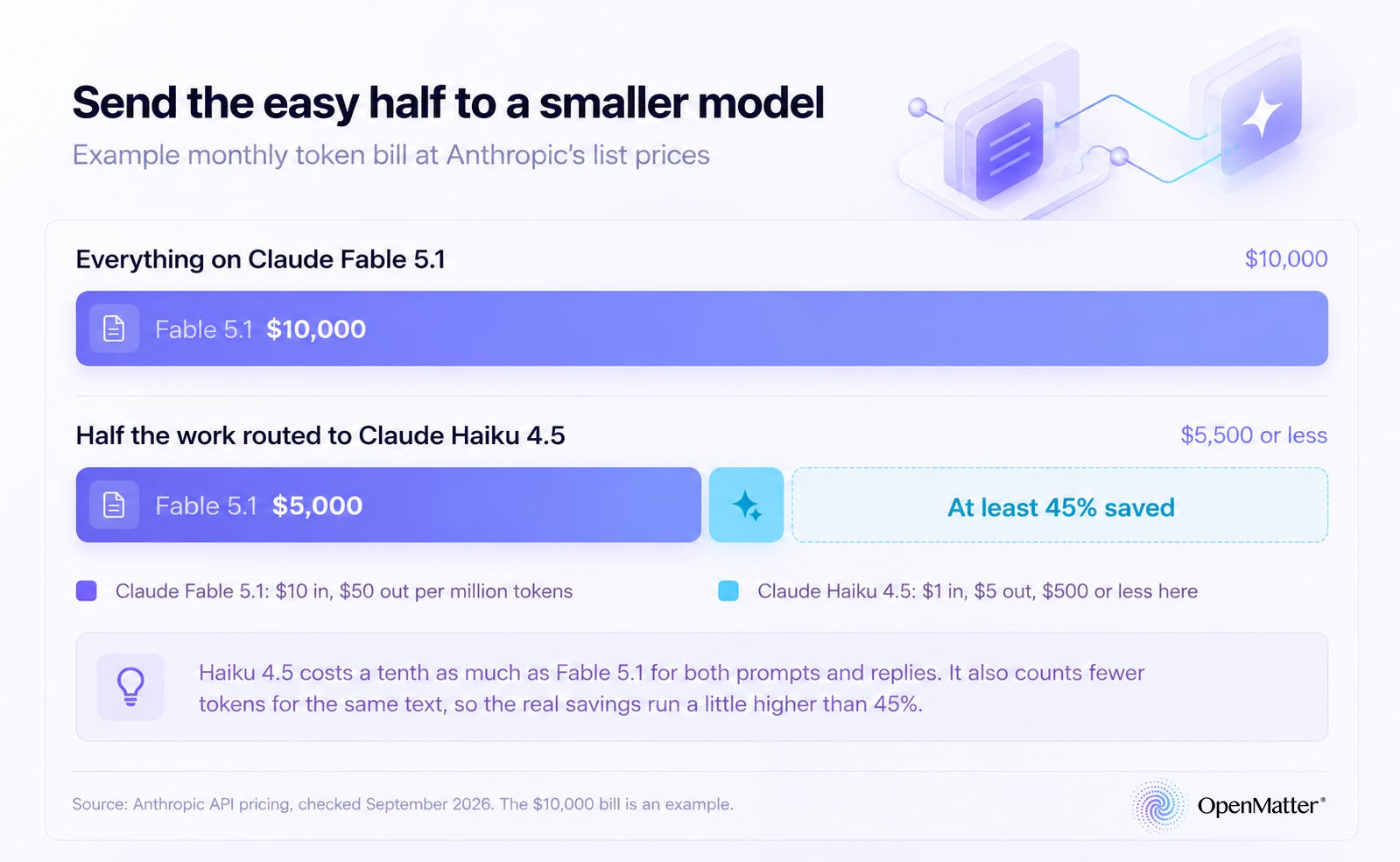
Model choice sets the price of every prompt. In Datavizor, you set rules that send each prompt to a model by keyword or length, and you can test them before they spend anything. At Anthropic’s current rates, Claude Haiku 4.5 costs a tenth of what Claude Fable 5.1 does. Say all your work runs on Fable 5.1 today, and half of it could run on Haiku. Routing that half cuts the bill by at least 45%. Each rule can also cap reply length, and on Anthropic’s list, reply tokens cost five times as much as prompt tokens.
ModelRouter can also send routine work to a model you run yourself, where prompts carry no per-token charge. It connects to servers running Ollama, vLLM, LM Studio, or llama.cpp, and Datavizor can set up an Ollama server from a template. OpenRouter’s private endpoints, an Enterprise add-on, cover only models it already lists, hosted by providers it supports. A model server you run yourself doesn’t meet that bar.
With ModelRouter, your providers bill you directly, at your rates, including any discount you’ve negotiated. OpenRouter charges a 5.5% fee on credit purchases, and 5% of bring-your-own-key usage above $25,000 a month, measured at list price.
Give Your Engineers Their Time Back
LiteLLM’s open-source gateway is free to download, and your team pays for it in time: setting up servers, securing them, and installing every upgrade. Upgrades carry risk. On March 24, 2026, attackers reached LiteLLM’s publishing credentials through a compromised security scanner inside its own build pipeline, then uploaded two poisoned versions to Python’s public package library. On every machine that installed them, the poisoned versions collected the SSH keys, cloud credentials, and API keys stored there and sent them to the attackers. Each of those machines needed new passwords and keys.
With ModelRouter, there’s no server to run. Datavizor deploys the gateway in one click on OpenMatter’s network, and each tool is set up once, against one address and one token. After that, switching models is one rule change with no redeploy, and replacing a provider key is one edit. When a model hits a rate limit, returns a server error, or stalls, the gateway retries once with the backup model you set, so nobody writes retry code into each app.
Keep Your Keys out of Reach
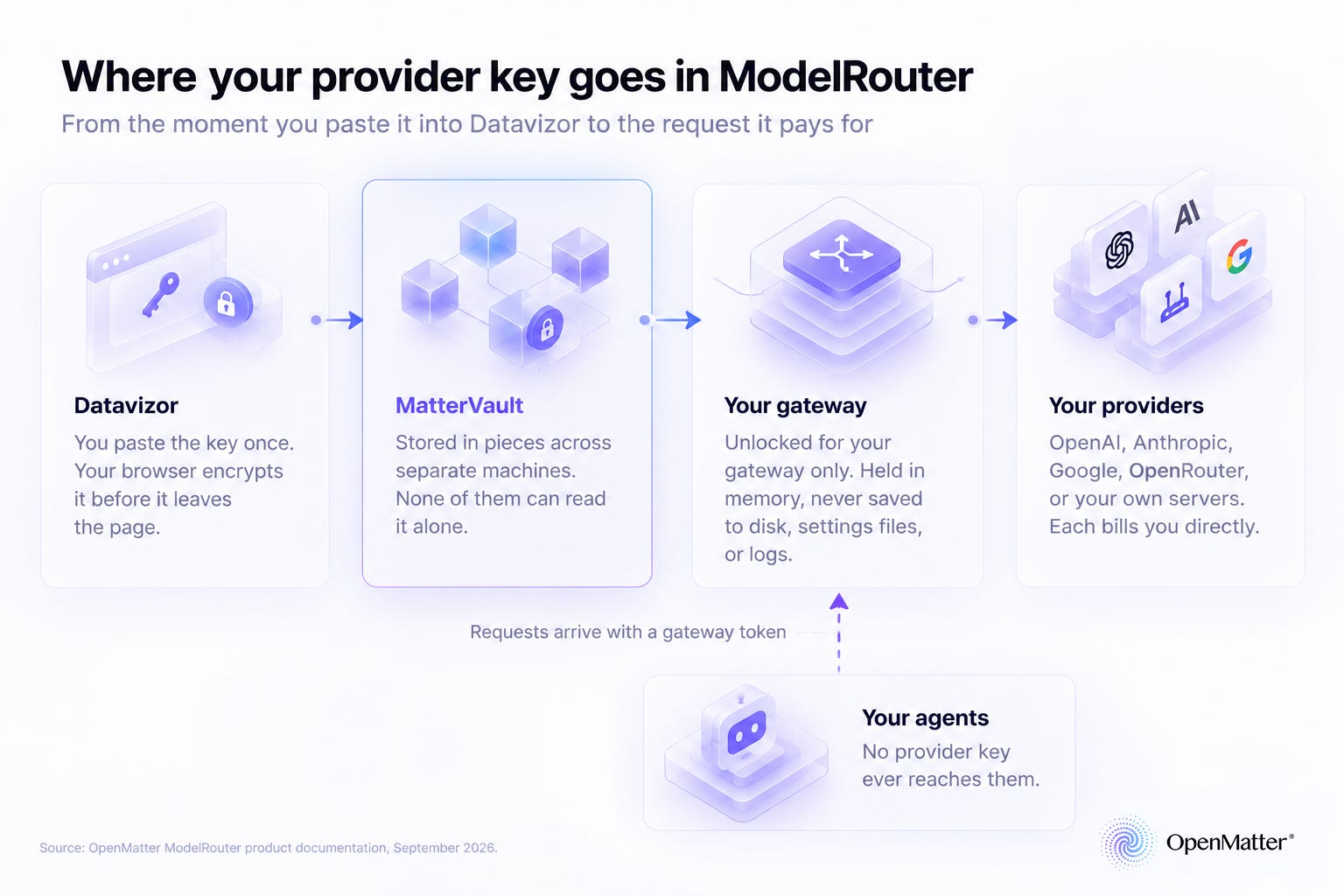
A provider API key works like a company credit card: anyone with a copy can run up charges on your account. OpenRouter stores the keys you bring. With LiteLLM, they sit on your servers, the kind of place that attack searched.
ModelRouter stores your key in pieces. Your browser encrypts it in Datavizor, and MatterVault™ splits it across separate machines, none of which can read it alone. Those machines unlock it only for your gateway, which holds it in memory and never saves it to disk, settings files, or logs.
Deploy Your Gateway in Datavizor Today
ModelRouter is live in the Datavizor console. Connect a model service, deploy the gateway, and save the starter flow, which already sends short prompts to a small model. Your savings start with the first one it routes. Already on OpenRouter? Keep it, and add it as one more endpoint your rules can use.
Open Datavizor to get started.
— The OpenMatter Team
If you know someone who would benefit from reading this article, please share it:
OpenMatter is building the verifiable trust layer that enables AI agents to securely collaborate on sensitive data sets. If you’re in a regulated industry and need a better way to prove that your data is secure, contact our team to learn how masked compute can help.